February 8, 2017

Finland again


Finland’s education system is considered one of the best in the world. In international ratings, it’s always in the top ten. However, the authorities there aren’t ready to rest on their laurels, and they’ve decided to carry through a real revolution in their school system.
Finnish officials want to remove school subjects from the curriculum. There will no longer be any classes in physics, math, literature, history, or geography.
The head of the Department of Education in Helsinki, Marjo Kyllonen, explained the changes:
“There are schools that are teaching in the old-fashioned way which was of benefit in the beginning of the 1900s — but the needs are not the same, and we need something fit for the 21st century. “
Instead of individual subjects, students will study events and phenomena in an interdisciplinary format. For example, the Second World War will be examined from the perspective of history, geography, and math. And by taking the course” Working in a Cafe," students will absorb a whole body of knowledge about the English language, economics, and communication skills.
This system will be introduced for senior students, beginning at the age of 16.
The general idea is that the students ought to choose for themselves which topic or phenomenon they want to study, bearing in mind their ambitions for the future and their capabilities. In this way, no student must pass through an entire course on physics or chemistry while all the time thinking to themselves “What do I need to know this for?”
The traditional format of teacher-pupil communication is also going to change. Students will no longer sit behind school desks and wait anxiously to be called upon to answer a question. Instead, they will work together in small groups to discuss problems.
The Finnish education system encourages collective work, which is why the changes will also affect teachers. The school reform will require a great deal of cooperation between teachers of different subjects. Around 70% of teachers in Helsinki have already undertaken preparatory work in line with the new system for presenting information, and, as a result, they’ll get a pay increase.
The changes are expected to be complete by 2020.

February 7, 2017

Training for jobs that don’t yet exist


The world’s education systems are failing our children by not preparing them for the workplace of the future. This is the key finding of a new report by the World Economic Forum, which puts forward a series of practical measures for aligning education and training with future job requirements.

Technology and globalization continue to reshape business models across all sectors and geographies, creating new types of jobs and disposing of old ones at great pace. However, monolithic, underfunded education and training systems around the world have fallen short of responding to this trend. This means that by the time they leave education, as many as two-thirds of children entering primary school today will not have the skills required to get a job. The impact will be worse for women who already have less than two-thirds of the economic opportunity that men have.

The report was put together by a panel of business leaders, policy-makers, unions, educational institutions and academics. It recommends that governments and the private sector work together in eight core areas to ensure the world’s children are equipped for the future.

1. Focus on the early years: Reinventing education starts in early childhood, where the focus should be on literacy and reading. Adequate childcare provision for working parents will be critical in both developed and developing economies.

2. Keeping it dynamic: Training curricula must be aligned with market demand for skills – both job-specific and generic, such as problem-solving and project management. The challenge will be to keep these curricula dynamic and responsive to evolving business needs. In Finland, one of the world’s top-performing nations in education, the curriculum is updated regularly to provide an overall framework, with room for local adaptation by the schools themselves.

3. Open-sourcing education: The report advocates adopting training innovations more quickly, opening up to alternative learning routes (such as Hackathons) and allowing for experimentation with new techniques. For example, the New York City Department of Education has created "Lab" schools and tasked them with reinventing teaching and learning. In Ghana, the US and France, schools are pioneering short courses in coding based on peer-to-peer teaching, project-based learning and gamification.

4. Taking teachers out of the ivory tower: To bring education and business closer together, the report recommends initiatives such as teacher "externships" in businesses, workplace mentoring and involving the private sector in teacher training.

5. Giving students a sense of the real world of work: Similarly, students should experience the world of work from early on – for example through internships and ongoing career coaching – to help them see a variety of career options and the skills required.

6. Addressing the vocational stigma: Vocational and technical education is critical to the world economy but has been neglected and often looked down on as second best. The World Economic Forum advocates promoting vocational and technical career paths more proactively and raising the quality of vocational training on offer. For example, Germany’s vocational training system sees apprentices divide their days between classroom instruction and on-the-job training at a company. Apprentices are paid and their training typically extends to between two and three years. Not only does this approach create an excellent talent pool, it also smooths the – often difficult – transition from education to the world of work.

7. Digital fluency: Digital skills will be fundamental to a wide range of careers, but "digital fluency" is not a given. The report highlights the need for a greater focus on ICT in teacher training and students’ work placements to address the growing digital skills crisis. One successful example comes from India, where the National Association of Software and Services Companies (NASSCOM) has partnered with NGOs and the Government of India to build National Digital Literacy Centers across the country to enable digital literacy.

8. Education, education, education: Given the rapid evolution of the job market, workers can no longer rely on just one skillset or narrow expertise to sustain long-term careers. The report advocates incentivizing employees to commit to lifelong learning so they continue to develop their skills or even retrain for new roles. For example, in Singapore, individuals receive an annual training allowance they can spend on a range of training courses all geared towards developing future-oriented skills. The fourth industrial revolution will turn the world of work as we know it on its head as it continues to unfold. The report suggests that, unless the world’s monolithic education systems can be reformed and rendered nimbler, their failings will come back to haunt future generations’ ability to prosper.

Source: World Economic Forum - February 2017

February 6, 2017

Use their competences


Nowadays all teachers realize that their students belong to the E- generation, and that they consume information on their own way.
These students are used to calculators, television, Play Station, computers, laptops, I-pads.

They sit in front of the computer and they consume their favorite products very quickly; if it's  not interesting enough they simply switch to another programme.

Computers are their sixth organ.
Students are like to be active themselves. They have the drive to explore.

Listening to long instruction is for them like reading the instruction guide of a new PlayStation programme.

And no-one will do it, they all start to explore immediately.

The first child that wants to read the instruction manual before he/she starts to work with that programme, has still to be born.

Students want to discover and do it themselves. That’s not a negative attitude, it is real motivation.

And we teachers must accept the changes in the consumption pattern of the audience in our classrooms.  

We are the professionals and that’s why we don’t want to serve them every day the same fast-food. Let’s be creative and keep them hungry.

Students want to be challenged to demonstrate their competences. They are not interested in the long demonstrations of the competences of the teacher. The only effect is that it will reduce their own competences.

Let’s focus on the 21st Century Skills to bring our program in harmony with their competences.

I am glad to work out this topic during the International Dalton Congress is Austria.


February 5, 2017

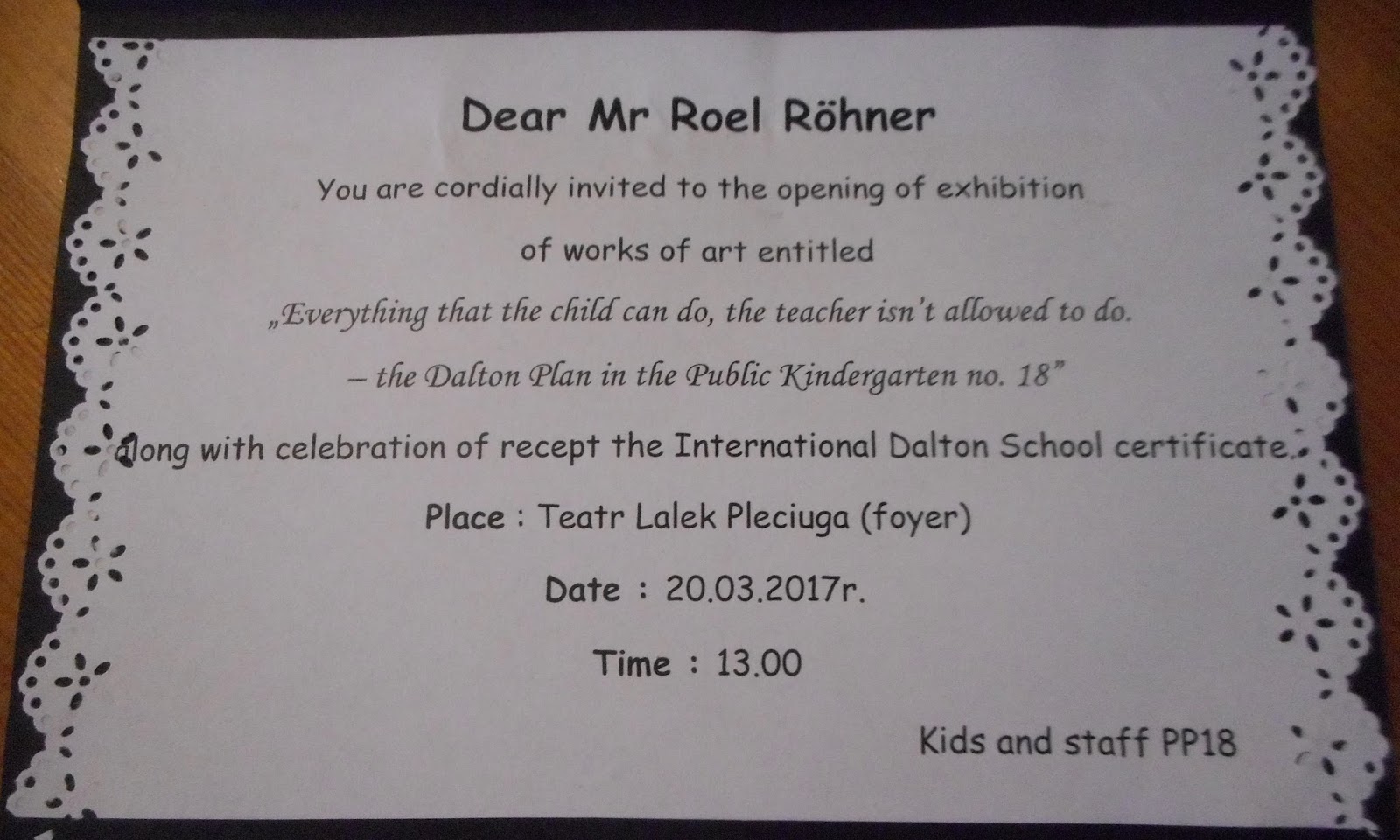
New Dalton school in Poland

I've got this beautiful invitation from the Public School nr. 18 in Szczecin.
The team of this school followed the training process organized by the Polish Dalton Association.
The official certificate will be celebrated on March 20. 2017.


February 3, 2017


The elements described in this section as “21st century student outcomes” (represented by the rainbow) are the skills, knowledge and expertise students should master to succeed in work and life in the 21st Century. 
Core Subjects
21st Century Themes Mastery of core subjects and 21st century themes are essential for students in the 21st century. Core subjects include English, reading or language arts, world languages, arts, mathematics, economics, science, geography, history, government and civics. We believe schools must move beyond a focus on basic competency in core subjects to promoting understanding of academic content at much higher levels by weaving 21st century interdisciplinary themes into core subjects:
• Global Awareness
• Financial, Economic, Business and Entrepreneurial Literacy
• Civic Literacy
• Health Literacy
Learning and Innovation Skills
Learning and innovation skills are what separate students who are prepared for increasingly complex life and work environments in the 21st century and those who are not.
They include:
• Creativity and Innovation
• Critical Thinking and Problem Solving
• Communication and Collaboration

Information, Media and Technology Skills
People in the 21st century live in a technology and media-driven environment, marked by access to an abundance of information, rapid changes in technology tools and the ability to collaborate and make individual contributions on an unprecedented scale. To be effective in the 21st century, citizens and workers must be able to exhibit a range of functional and critical thinking skills, such as:
• Information Literacy
• Media Literacy
• ICT (Information, Communications and Technology) Literacy
Life and Career Skills
Today’s life and work environments require far more than thinking skills and content knowledge. The ability to navigate the complex life and work environments in the globally competitive information age requires students to pay rigorous attention to developing adequate life and career skills, such as:
• Flexibility and Adaptability
• Initiative and Self-Direction
• Social and Cross-Cultural Skills
• Productivity and Accountability
• Leadership and Responsibility
BY: The Partnership for 21st Century Skills

February 2, 2017

Long live the teacher


In one of his books Woody Allen writes: “My education was dismal. I went to a series of schools for mentally disturbed teachers”.

But nevertheless he survived his education and at least it brought him to a unique sense of humour.

If teachers can weave humour through the daily programme, they can really touch the future with their students. Long live the teacher should be the reaction of the students.